When Your Water Line Needs Replacing: Meter to House
The pipe you never see can fail quietly, and replacing it is a bigger project than most homeowners expect.
October 1, 2026 · 4 min read
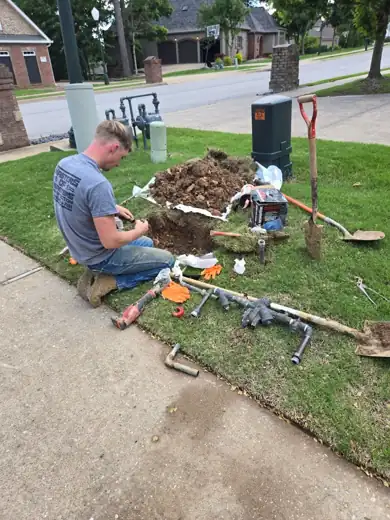
Your water service line is the pipe that carries water from the city meter to your house. You never see it, so most homeowners only think about it when something goes wrong: a yard that will not dry out, pressure that has faded, a bill that makes no sense. When this line fails, it is usually because the pipe itself has reached the end of its useful life, and that is a different problem from a leaky faucet. Here is how to tell when a line needs replacing, and what the work looks like from the first call to the last shovel of topsoil, in Springdale, Rogers, Fayetteville and across Northwest Arkansas.
Why age and material matter
Service lines go in when a house is built, and the pipe material depends on the era. Older homes may have galvanized steel, which corrodes from the inside and narrows over time. Others have copper, some have early plastic piping that has turned brittle, and newer lines are usually flexible plastic. A line is not necessarily bad because it is old by the calendar. It is bad when its material has started to fail.
One customer, McCoy K, described exactly this kind of job in a Google review: “I had a water leak and ended up needing to have my line replaced from the meter to the house due to the age and material of the pipe.” That sentence is the heart of the decision. When a pipe is failing because of what it is made of, patching one spot tends to move the problem down the line rather than solve it.
Signs the service line is the problem
- Wet, soft or unusually green ground between the meter and the house
- Water pressure that has dropped across the whole house, not just one faucet
- A water bill that climbs with no change in how you use water
- A meter that keeps moving when every fixture in the house is off
- Water surfacing in the yard, or a sunken patch of ground along the path of the line
Find the leak before anyone digs
A replacement decision should come after the leak is actually located, so you know whether you are dealing with one failed joint or a line that is failing along its whole length. That is where leak detection earns its place. Masters of Disasters uses electronic leak detection, camera inspections and water pressure testing, and offers a complimentary leak evaluation.
What the job involves
Replacing a service line is a small construction project, and it has more steps than most people expect. In McCoy K's words, the crew “handled everything from utility line marking to permits and getting the city out to inspect and sign off on the repair.” Here is the general sequence:
- Utility locates. Before any digging, buried gas, electric, communication and sewer lines are marked so the trench does not hit them.
- Permits. Whether a permit is needed, and who issues it, depends on the city and the job. Someone has to take care of it before work starts.
- Shutting off and trenching. The water is shut off, and a trench is opened along the path of the line, using machine digging where it is safe and hand digging near anything delicate.
- New line, connections and testing. The new pipe is run, connected at the meter side and at the house, and tested before it is covered.
- City inspection and sign-off. The city looks at the work and approves it, as it did on McCoy K's job.
- Backfill and restoring the yard. The trench is closed, the soil is put back, and the lawn and landscaping are dealt with.
The yard is part of the job
Digging is the part homeowners worry about most, and fairly so. Another customer, Cory Wood, wrote that the crew did an amazing job “even putting landscaping items back where they were and relocating a bush that was in the way. Besides now having water back at my house, you can hardly tell they were ever here!” A good crew plans the trench route around trees, beds, walkways and fences where it can, and puts things back when the work is done.
When the plan changes mid-job
Buried pipe is full of surprises: an old repair no one knew about, a line that does not run where it was assumed to, or a section in worse shape than expected. McCoy K wrote that Tim “gave a fair quote and ensured me that they would get the job done for that price, no matter what, and they did even when the original plan didn't work out.”
Masters of Disasters advertises flat rate upfront pricing with no hidden fees, which is the right thing to ask any contractor about before you sign. Ask how changes in scope are handled, and get the answer in writing.
Questions to ask before you hire
- Who requests the utility locate and who handles the permit?
- How will the leak be confirmed before the line is replaced?
- What happens to the yard, landscaping, fences and driveway edges?
- What is the plan if the trench shows something unexpected?
- Who schedules the city inspection and makes sure it is signed off?
Masters of Disasters offers a free leak evaluation; call (479) 659-5002. The crew works out of Springdale and across Northwest Arkansas, and the Water Leak Detection & Repair page explains how they find the source before a trench is opened.
Masters of Disasters Leak Detection, Plumbing & Air, (479) 659-5002
Call (479) 659-5002