Sewer Liner or Dig Repair? How to Decide
Roots, shifting soil and aging pipe wear sewer lines down, and the right fix depends on what the camera shows.
October 1, 2026 · 4 min read
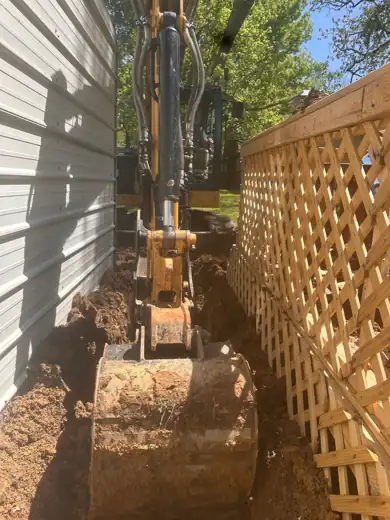
A sewer line does its job out of sight until the day it stops. By then you may be dealing with slow drains, gurgling, or a backup. In Northwest Arkansas, soil shifts, trees grow right up to foundations, and heavy seasonal rain soaks the ground, so sewer lines face a few predictable threats. Here is how to tell whether yours is failing, and how to think about lining it from the inside versus digging it up.
What goes wrong with sewer lines
Masters of Disasters names four common causes: shifting soil, tree root intrusion, aging pipes, and heavy seasonal rain. Each one works on a pipe in a different way.
- Shifting soil can pull joints apart or bend a pipe so it sags and holds water instead of draining.
- Tree roots find the tiny gap at a joint, grow in looking for moisture, and thicken until they slow the flow or crack the pipe.
- Aging pipe, such as clay tile or older cast iron, can crack, flake or corrode as the years pass.
- Heavy rain saturates the ground, loads weak spots, and exposes cracks that dry weather hides.
Signs your sewer line is failing
One clogged drain is usually a local problem. When several fixtures are sluggish at once, or the same clog keeps coming back after it has been cleared, the trouble is likely in the main line leaving the house. Watch for these:
- Slow drains in more than one fixture
- Gurgling from a toilet or tub when another fixture drains
- Sewage odors indoors or in the yard
- A backup in the lowest drain in the house, often a shower or floor drain
- Wet or sunken patches of lawn along the path of the line
- Repeated clogs that return soon after being cleared
Start with a camera inspection
Before anyone chooses between lining and digging, the pipe needs to be looked at. A camera is fed through the line to show the inside: roots, cracks, offset joints, low spots where the pipe sags, and sections that have collapsed. The footage tells you where the problem is, how far it runs, and what kind of fix fits.
Masters of Disasters lists sewer line inspections and leak and break detection with camera inspections among its services, along with smoke testing to trace breaks that cannot be seen. Skipping this step and agreeing to a repair sight unseen is how people end up digging in the wrong place or fixing the wrong thing.
When lining from the inside makes sense
A sewer liner is a flexible tube saturated with resin that is pulled into the old pipe and cured in place, forming a new pipe inside the old one. Masters of Disasters describes its liner work as a way to “restore damaged sewer pipes from the inside, reducing the need for major digging.”
Lining tends to make sense when the existing pipe is still continuous and in line but has cracks, root intrusion at the joints, or surface deterioration. It is especially useful where digging would mean tearing up a driveway, a patio, a mature tree, a flower bed, or working under a slab. A lined pipe also has far fewer joints for roots to find, which helps with the problem that brought many homeowners in to begin with.
When a dig repair is the right call
Lining cannot fix everything. A pipe that has collapsed, has a severe offset, or has sagged enough to hold standing water usually needs to be uncovered and repaired or replaced, because a liner follows the shape of the pipe it goes into. If the pipe is not the shape of a pipe anymore, there is nothing sound for the liner to follow.
Sometimes a short failed section can be handled with a spot repair at a single dig, while the rest of the line stays as it is. Other times the better answer is a full replacement or repiping run. Masters of Disasters lists sewer line repairs and replacements and repiping alongside liner installation, so the recommendation can follow the footage instead of a single method looking for a problem to fit.
Questions to ask before you decide
- Can I see the camera footage, and can you show me where the problem is?
- Is the pipe intact enough for a liner, or is a section collapsed or sagging?
- What would a dig repair disturb: driveway, trees, landscaping, a slab?
- Is the damage in one spot or along the whole run?
- Is this a residential line, or does it serve a commercial property? Masters of Disasters does both.
A trustworthy answer follows from the inspection, and it is fine to ask for the reasoning in plain words. If a plan to dig and a plan to line both seem possible, the footage should show why one is a better fit for your property.
A note for homeowners around Springdale and beyond
Whether you are in Springdale, Lowell, Bella Vista or out toward Prairie Grove, mature trees are one of the best things about a lot and one of the toughest things on an old sewer line. If the line is old and the trees are older, have it looked at before a heavy rain makes the decision for you.
Masters of Disasters offers free estimates on sewer work; call (479) 659-5002. The Sewer Liners page and the Gas & Sewer Lines page on this site list what the crew does, including inspections, liner installation and repairs.
Masters of Disasters Leak Detection, Plumbing & Air, (479) 659-5002
Call (479) 659-5002